Atomic and Molecular Clusters
arXiv:physics.atm-clus
Atomic and molecular clusters, nanoparticles, and their spectroscopy.
Atomic and molecular clusters, nanoparticles, and their spectroscopy.
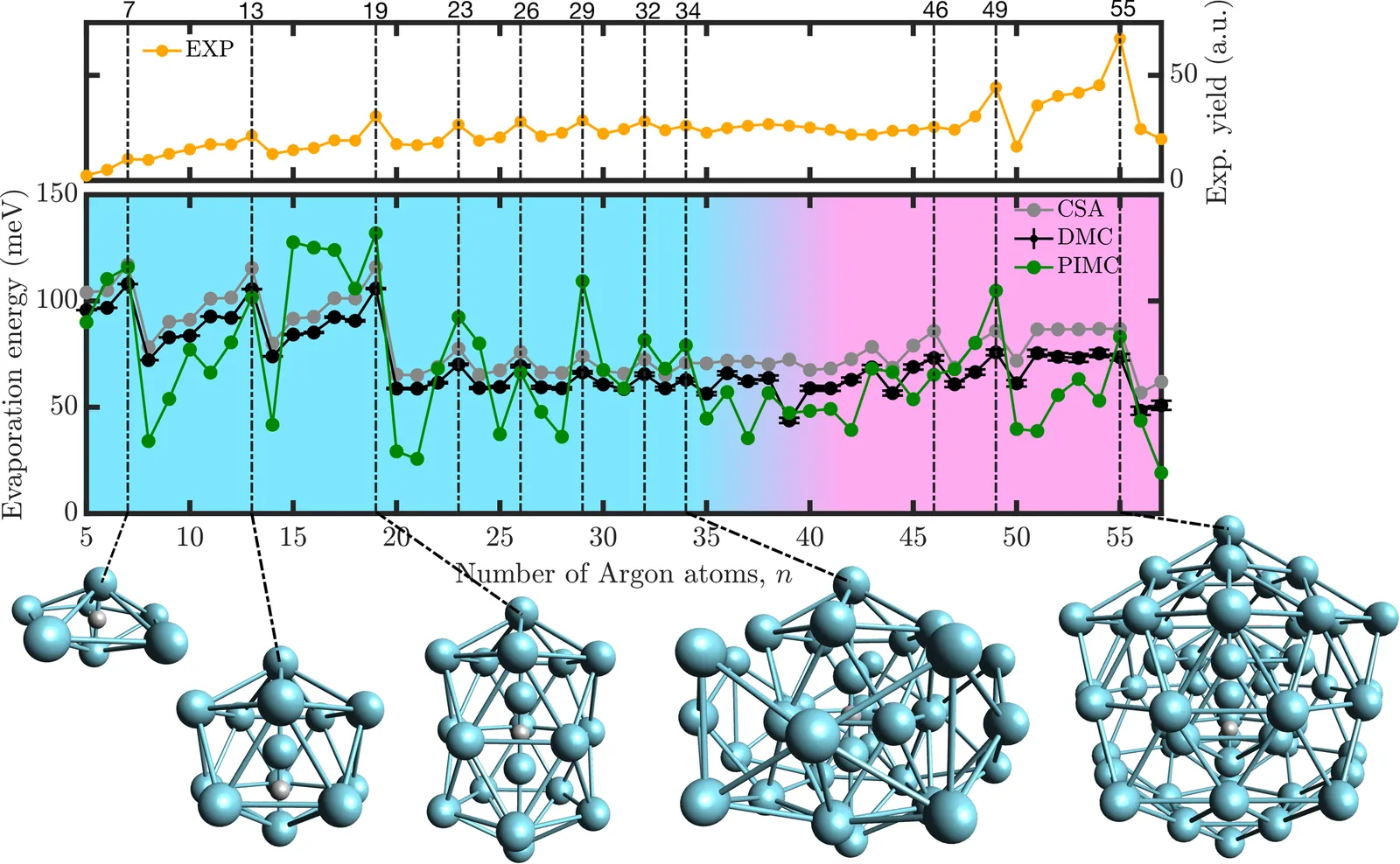
The structural properties of rare-gas clusters can be primarily described by a simple sphere packing model or by pairwise interactions. Remarkably, adding a single proton yields a large set of magic numbers that has remained unexplained. In this Letter, we unravel their origin by combining quantum Monte Carlo techniques with many-body ab initio potentials that correctly capture the proton's coordination environment. Thanks to this approach, we find that argon atoms are mainly localized around the classical minimum, resulting in a particularly rigid behavior in stark contrast to lighter rare-gas clusters. Moreover, as cluster size increases, we identify a clear structural transition from many-body coordination-driven stability to a regime dominated by two-body interactions, reflecting a reshaping of the underlying potential energy landscape.
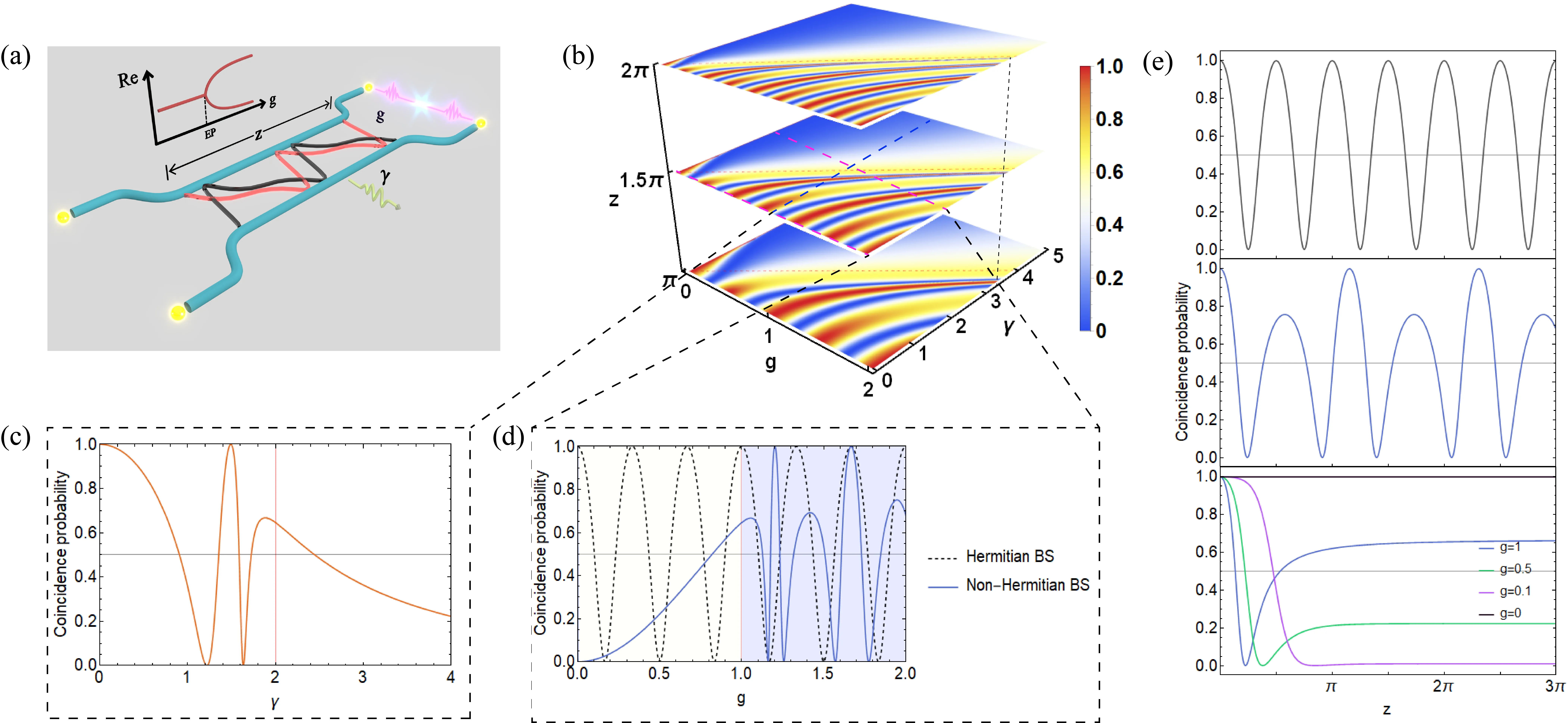
Quantum interference underpins many quantum information protocols but is typically studied in lossless Hermitian systems. Here, we reveal an exceptional point induced phase transition in two photon Hong Ou Mandel interference within a lossy coupled waveguide system. In the PT symmetric phase. interference is ultrasensitive to coupling strength, yielding sharp bunching antibunching switches. In the PT broken phase. it becomes robust oscillation free and propagation independent with coincidence probability stably tunable via coupling. These regimes enable enhanced quantum sensing and reliable two photon control for robust quantum information processing.
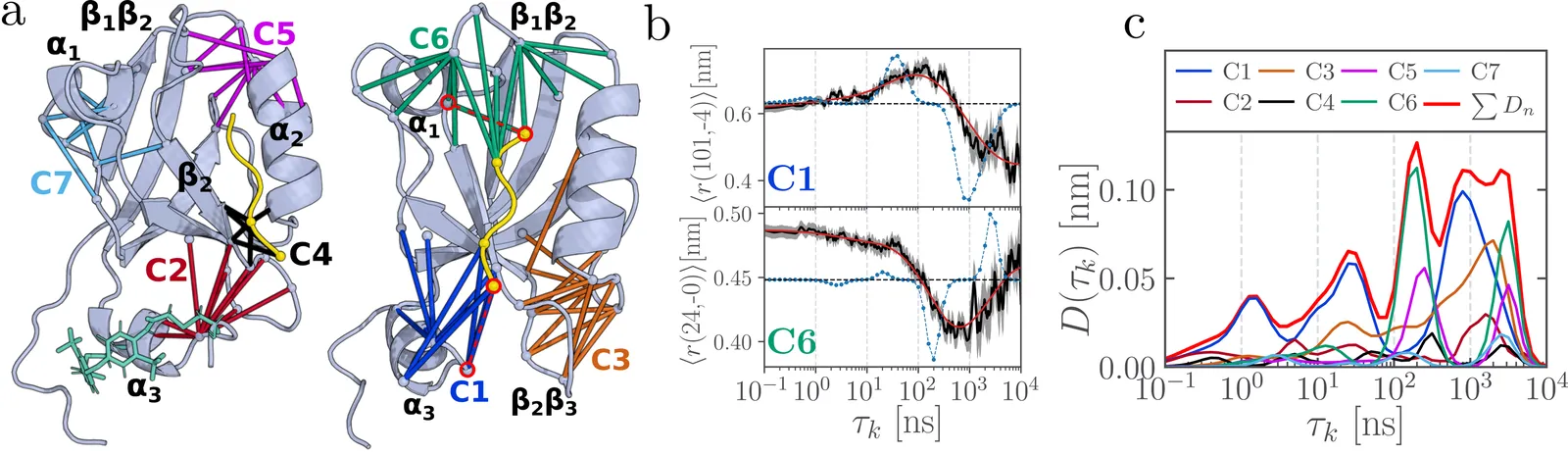
Allostery, the intriguing phenomenon of long-range communication between distant sites in proteins, plays a central role in biomolecular regulation and signal transduction. While it is commonly attributed to conformational rearrangements, the underlying dynamical mechanisms remain poorly understood. The contact cluster model of allostery [J. Chem. Theory Comput. 2024, 20, 10731] identifies localized groups of highly correlated contacts that mediate interactions between secondary structure elements. This framework proposes that allostery proceeds through a multistep process involving cooperative contact changes within clusters and communication between distant clusters, transmitted through rigid secondary structures. To demonstrate the validity and generality of the model, this Perspective employs extensive molecular dynamics simulations ($\sim 1\,$ms total simulation time) of four different photoswitchable PDZ domains and studies how different domains, ligands and perturbations influence both the contact clusters and their dynamical evolution. These analyses reveal several recurring clusters that represent shared flexible structural modules, such as loops connecting $β$-sheets, and show that the characteristic timescales of the nonequilibrium protein response can be directly associated with the motions of individual contact clusters. Thus, the dynamic decomposition of PDZ domains into contact clusters uncovers a modular, dynamics-based architecture that underlies and facilitates long-range allosteric communication.
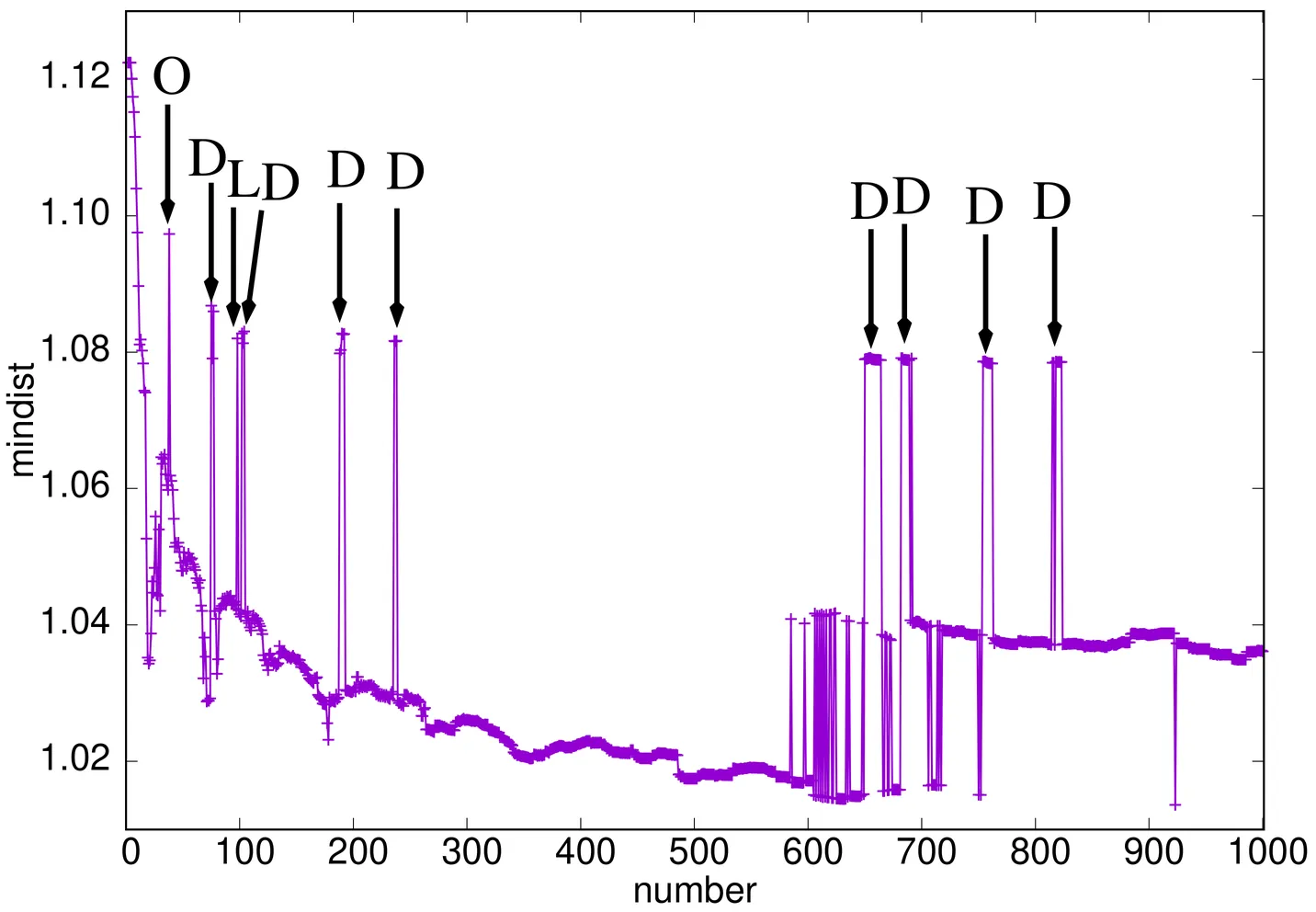
Good a-priori bounds on the smallest pairwise distance $r_{\rm{min}}(\mbox{LJ}_N^{\rm{gmin}})$ for a three-dimensional (3D) Lennard-Jones $N$-body cluster of globally minimal energy can significantly reduce the computational search space in the NP-hard problem to find this configuration. In this contribution the virial theorem is exploited for this purpose. We prove that if a configuration ${C}^{(N)}$ is a member of $\mbox{LJ}_N^{\rm{equ}}$ (the stationary points), then $r_{\rm{min}}({C}^{(N)}) \leq r_{\rm{min}}(\mbox{LJ}_2^{\rm{gmin}})$. It is also shown that if ${C}^{(N)}\in$ LJ$_N^{\rm{gmin}}\subset$ LJ$_N^{\rm{equ}}$, equality holds if and only if $N\in\{2,3,4\}$. We conjecture that $r_{\rm{min}}(\mbox{LJ}_N^{\rm{gmin}}) >1$ in units for which $r_{\rm{min}}(\mbox{LJ}_2^{\rm{gmin}})= 2^\frac16 \approx 1.122462048$. This conjectured lower bound, if correct, would improve the best lower bound currently known, $r_{\rm{min}}(\mbox{LJ}_N^{\rm{gmin}})\geq 0.767764$, by about 25$\%$. In these units the smallest minimal pair distance found through numerical searches for LJ$_N^{\rm{gmin}}$ with $N\leq 1000$ is $r_{\rm{min}}(\mbox{LJ}_{923}^{\rm{gmin}}) \approx 1.01361$, so the conjectured lower bound would presumably be close to optimal. From the virial theorem we obtain an identity for any ${C}^{(N)}\in \mbox{LJ}_N^{\rm{equ}}$, which expresses $r_{\rm{min}}({C}^{(N)})$ in terms of the distribution of relative distances in ${C}^{(N)}$. This result reveals interesting connections with the Erdős distance, and related problems.
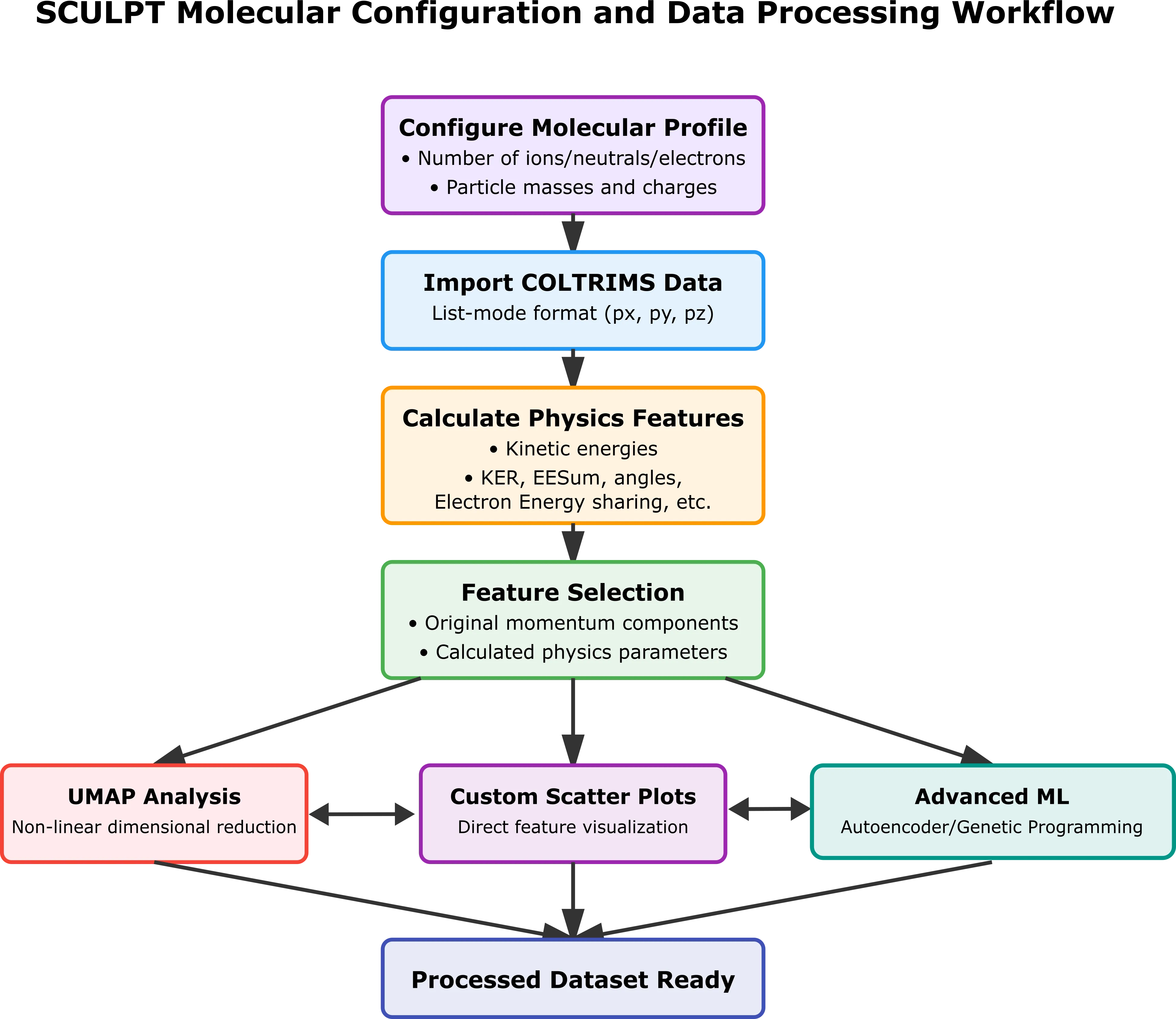
We present SCULPT (Supervised Clustering and Uncovering Latent Patterns with Training), a comprehensive software platform for analyzing tabulated high-dimensional multi-particle coincidence data from Cold Target Recoil Ion Momentum Spectroscopy (COLTRIMS) experiments. The software addresses critical challenges in modern momentum spectroscopy by integrating advanced machine learning techniques with physics-informed analysis in an interactive web-based environment. SCULPT implements Uniform Manifold Approximation and Projection (UMAP) for non-linear dimensionality reduction to reveal correlations in highly dimensional data. We also discuss potential extensions to deep autoencoders for feature learning, and genetic programming for automated discovery of physically meaningful observables. A novel adaptive confidence scoring system provides quantitative reliability assessments by evaluating user-selected clustering quality metrics with predefined weights that reflect each metric's robustness. The platform features configurable molecular profiles for different experimental systems, interactive visualization with selection tools, and comprehensive data filtering capabilities. Utilizing a subset of SCULPT's capabilities, we analyze photo double ionization data measured using the COLTRIMS method for 3-body dissociation of the D2O molecule, revealing distinct fragmentation channels and their correlations with physics parameters. The software's modular architecture and web-based implementation make it accessible to the broader atomic and molecular physics community, significantly reducing the time required for complex multi-dimensional analyses. This opens the door to finding and isolating rare events exhibiting non-linear correlations on the fly during experimental measurements, which can help steer exploration and improve the efficiency of experiments.