High Energy Physics
Particle physics theory, phenomenology, and experiments
Particle physics theory, phenomenology, and experiments
These notes are based on lecture courses I gave to third year mathematics students at Cambridge. They could form a basis of an elementary one--term lecture course on integrable systems covering the Arnold-Liouville theorem, inverse scattering transform, Hamiltonian methods in soliton theory and Lie point symmetries. No knowledge beyond basic calculus and ordinary differential equation is assumed.
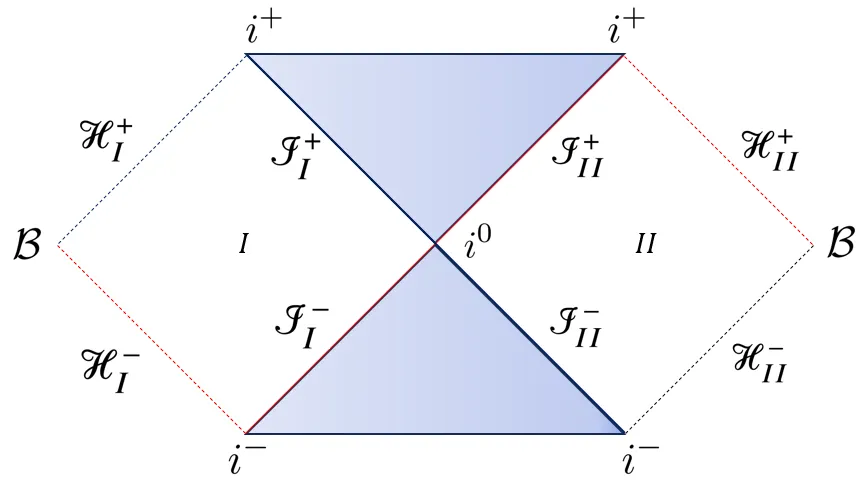
Black hole thermodynamics provides a unique setting in which general relativity, quantum field theory, and statistical mechanics converge. In semiclassical gravity, this interplay culminates in the generalized second law (GSL), whose modern proofs rely on information theoretic techniques applied to algebras of observables defined on null hypersurfaces. These proofs exhibit close structural parallels with the thermodynamics of open quantum systems governed by Markovian dynamics. In this work, we draw parallels between the dynamics of quantum fields in regions bounded by non expanding causal horizons and the thermodynamics of quantum systems weakly coupled to equilibrium reservoirs. We introduce a dictionary relating late time boundary conditions to the choice of reservoir, vacuum states to fixed points of the dynamics, and modular Hamiltonians to thermodynamic potentials. Building on results from a companion paper on dual generalized second laws at future null infinity, we show that additional terms appearing in the associated thermodynamic potentials admit a natural interpretation as work contributions. We demonstrate that certain non thermal vacuum states at null infinity allow for the operation of autonomous thermal engines and enable work extraction from the radiation. Extending the analysis to the Unruh vacuum in Schwarzschild and Kerr backgrounds, we obtain generalized grand potential type laws incorporating grey body effects and angular momentum fluxes. Altogether, our results clarify the thermodynamic description of black hole dynamics and place it within the broader framework of open quantum thermodynamics.
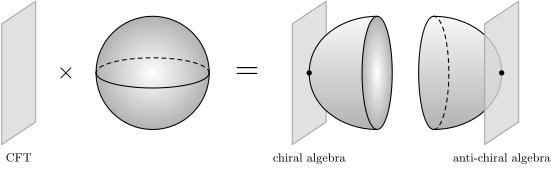
Motivated by the observation that $2+2=4$, we consider four-dimensional $\mathcal{N}=2$ superconformal field theories on $S^2\timesΣ$, turning on a suitable rigid supergravity background. On the one hand, reduction of a four-dimensional theory ${T}$ on a Riemann surface $Σ$ leads to a family $\mathscr{F}[{T}, Σ]$ of two-dimensional $(2,2)$ unitary SCFTs, a two-dimensional analog of the four-dimensional theories of class $\mathscr{S}$. On the other hand, reduction on $S^2$ yields a non-unitary two-dimensional CFT $\mathscr{C}[{T}]$ whose chiral algebra is the same as the one associated to ${T}$ by the standard SCFT/VOA correspondence. This construction upgrades the vertex operator algebra to a full-fledged two-dimensional CFT. What's more, it leads to a novel 2d/2d correspondence, a "$2+2 = 4$" analog of the "$4+2=6$" AGT correspondence: the $S^2$ partition function of $\mathscr{F}[{T}; Σ]$ is computed by correlation functions of $\mathscr{C}[{T}]$ on $Σ$. The elliptic genus of $\mathscr{F}[{T}; Σ]$ is instead computed by a topological QFT $\mathscr{E}[T]$ on $Σ$. A central question is whether one can give a purely two-dimensional presentation of the family $\mathscr{F}[{T}; Σ]$ of $(2, 2)$ theories. We propose an algorithm to realize the $(2, 2)$ theories as gauged linear sigma models when ${T}$ is an Argyres-Douglas theory of type $(A_1, A_{2k})$ and $Σ$ an $n$-punctured sphere. We perform stringent checks of our conjecture for $k=1$ and $k=2$.
 2601.00605
Recent developments in generalized symmetries have provided new insights into quantum field theories. Within this framework, photons can be understood as Nambu-Goldstone modes associated with a spontaneously broken higher-form symmetry. In this work, we develop an effective field theory that builds on this symmetry structure to describe the real-time dynamics of photons in insulating media at finite temperature. Combining the Schwinger-Keldysh formalism with the generalized coset construction, we formulate a symmetry-based effective action that incorporates both conservative and dissipative effects. The effective theory implements the dynamical Kubo-Martin-Schwinger symmetry, ensuring consistency with the fluctuation-dissipation relation and Onsager's reciprocal relations. Within this framework, we derive the entropy current associated with dissipative photon dynamics and demonstrate the non-negativity of its divergence, in accordance with the second law of thermodynamics. We also clarify the symmetry origin of the gauge redundancy in the unbroken phase within the Schwinger-Keldysh framework, relating it to strong and weak realizations of higher-form symmetries. Our results provide a model-independent effective description of photon dynamics in insulating media at finite temperature.
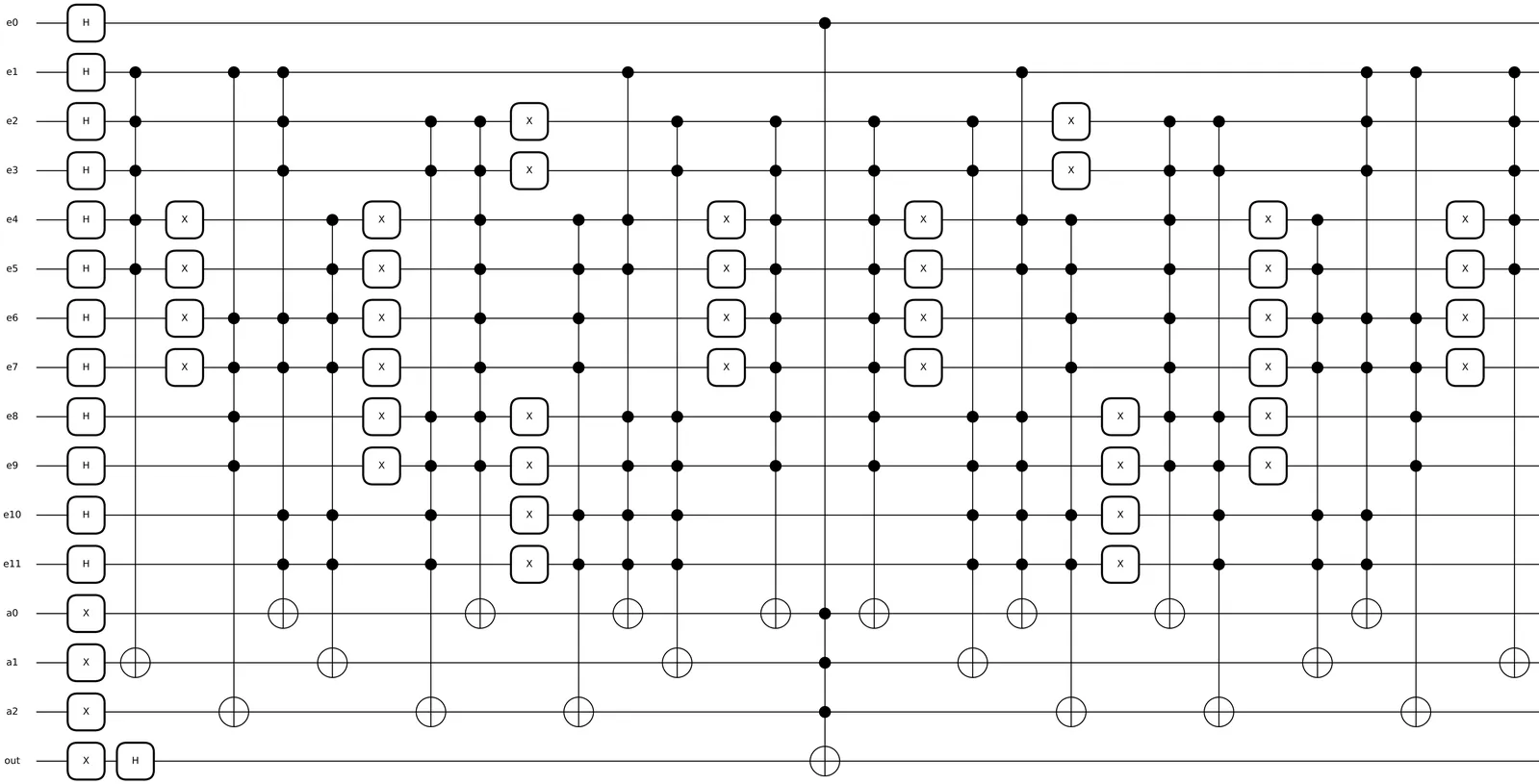
High-energy colliders, such as the Large Hadron Collider (LHC) at CERN, are genuine quantum machines, so, in line with Richard Feynman's original motivation for Quantum Computing, the scattering processes that take place there are natural candidates to be simulated on a quantum system. Potential applications range from quantum machine learning methods for collider data analysis, to faster and more precise evaluations of intricate multiloop Feynman diagrams, more efficient jet clustering, improved simulations of parton showers, and many other tasks. In this work, the focus will be on two specific applications: first, the identification of the causal structure of multiloop vacuum amplitudes, a key ingredient of the Loop-Tree Duality and an area with deep connections to graph theory; and second, the integration and sampling of high-dimensional functions. The latter constitutes a first step toward the realization of a fully fledged quantum event generator operating at high perturbative orders.
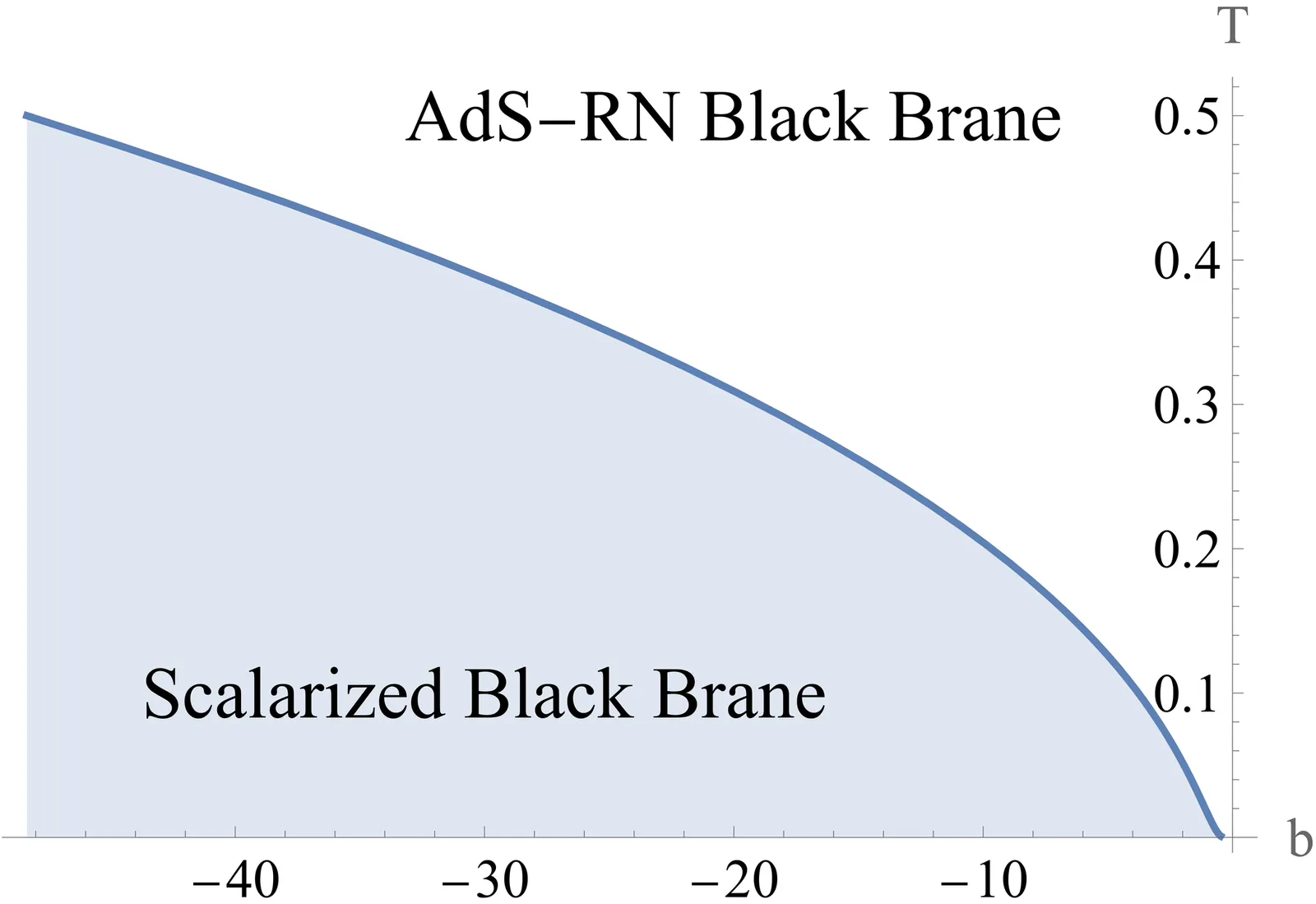
We investigate the holographic mixed-state entanglement measures in the Einstein-Maxwell-Scalar (EMS) theory. Several quantities are computed, including the holographic entanglement entropy (HEE), mutual information (MI), entanglement wedge cross-section (EWCS), and butterfly velocity ($v_B$). Our findings demonstrate that these measures can effectively diagnose phase transitions. Notably, EWCS and MI, as mixed-state entanglement measures, exhibit behavior opposite to that of the HEE. Additionally, we study the butterfly velocity, a dynamic quantum information measure, and observe that it behaves differently from the static quantum information measures. We propose that the butterfly velocity is initially dominated by entanglement and subsequently by thermal entropy as the coupling constant increases. Moreover, we examine the scaling behavior of the holographic entanglement measures and find that all the critical exponents are equal to $1$, which is twice that of the scalar field. We also explore the inequality between EWCS and MI, noting that the growth rate of MI consistently exceeds that of EWCS during phase transitions. These features are expected to be universal across thermodynamic phase transitions, with the inequalities becoming more significant as one moves away from the critical point.
2601.00662We construct in detail the irreducible representations of the BMS group with super rotations in three and four dimensions that have the same rest frame momenta as the massive and massless Poincare point particles. We compare these representations to those of the Poincare group and also to the analogous representations of global BMS. We argue that these extended BMS representations are carried by a string rather than a point particle. The super rotations play a crucial role in our discussions.
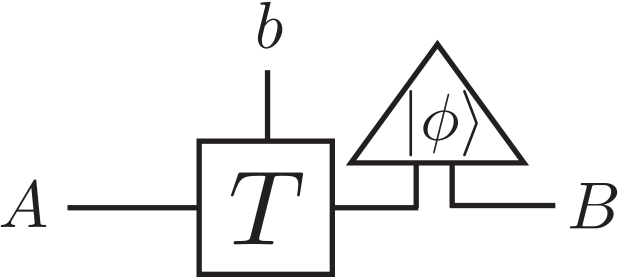
Gauge/gravity duality is often described as a quantum error correcting code. However, as seen in the Jafferis-Lewkowycz-Maldacena-Suh (JLMS) formula, exact quantum error correction with complementary recovery (and thus entanglement wedge reconstruction) emerges only in the limit $G \to 0$. As a result, precise arguments controlling error terms have focused on what we call `small' codes which, as $G \to 0$, describe only perturbative excitations near a given classical solution. Such settings are quite restrictive and, in particular, they prohibit discussion of any modular flow that would change the classical background. As a result, they forbid consideration of modular flows generated by semiclassical bulk states at order-one modular parameters. In contrast, we present a single `large' code for the bulk theory that can accommodate such flows and, in particular, in the $G \to 0$ limit includes superpositions of states associated with distinct classical backgrounds. This large code is assembled from small codes that each satisfy an approximate Faulkner-Lewkowycz-Maldacena formula. In this extended setting we clarify the meaning of the (approximate) JLMS relation between bulk and boundary modular Hamiltonians and quantify its validity in an appropriate class of states.
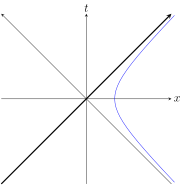
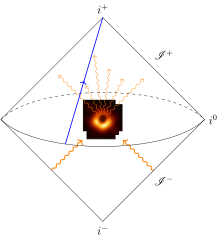
These are the lecture notes for a course at the "Roberto Salmeron School in Mathematical Physics" held at the University of Brasilia in September 2025, to be published in the proceedings book "Modern topics in mathematical physics." The course provides a concise and biased introduction to black hole thermodynamics. It covers the laws of black hole mechanics, Hawking radiation, Euclidean quantum gravity methods, and AdS black holes.

Several recent works have revealed a simplicity in equal-time correlators that is absent in their wavefunction counterparts. In this letter, we show that this arises from the simple fact that the correlator is obtained by integrating Feynman propagators over the full spacetime, as opposed to the half-space for the wavefunction. Several striking new properties of correlators for any graph are made obvious from this picture. Certain patterns of poles that appear in the wavefunction do not appear in the correlator. The correlator also enjoys several remarkable factorization properties in various limits. Most strikingly, the correlator admits a systematic Laurent expansion in the neighborhood of every pole, with the first subleading term vanishing for every pole. There is an especially simple understanding of the expansion around the total energy pole up to second order, given by a differential operator acting on the amplitude. Finally, we show how these results extend beyond single graphs to the full correlator in Tr $φ^3$ theory.

We study the impact of background-induced forces on dark matter (DM) annihilation and their implications for indirect detection. In the presence of a finite number density of background particles, loop-level interactions can generate an effective force that is significantly enhanced relative to the vacuum case. We construct a two-component DM model in which the dominant component is a fermionic particle $χ$ and the subdominant component is an ultralight pseudoscalar particle $φ$. The annihilation of $χ$ proceeds through the p-wave channel and produces gamma-ray emission. The finite density of $φ$ particles induces a background-enhanced force between $χ$ particles, leading to a sizable Sommerfeld enhancement of the annihilation. We show that a viable region of parameter space in this model can account for the gamma-ray excess observed in the Galactic Center using Fermi-LAT data. The background-induced force substantially amplifies the Sommerfeld enhancement and thus enlarges the parameter space capable of explaining the excess, highlighting the importance of background effects in astrophysical environments.
We investigate energy correlators in four-dimensional gravitational theories, which provide a simple class of infrared-finite observables. We compute the one- and two-point energy correlators at one loop in $\mathcal{N}=8$ supergravity and in pure Einstein gravity, with particular emphasis on the contact terms arising from the interplay between virtual corrections and real emissions. We explicitly demonstrate the cancellation of infrared divergences and verify the Ward identities associated with energy-momentum conservation. In the back-to-back limit, we derive an all-order expression for the energy-energy correlator, showing that it is governed by universal soft-graviton dynamics. We further introduce a particularly simple beam-averaged energy-energy correlator and compute it in different gravitational theories, including tree-level string theory. The resulting correlators exhibit analyticity and polynomial boundedness, allowing for the formulation of dispersion relations, which we explore. Finally, we discuss additional singularities of the gravitational energy correlators, absent in QCD, that originate from the long-range nature of the gravitational interactions.

We study the quantum field theory of zero temperature perfect fluids. Such systems are defined by quantizing a classical field theory of scalar fields $φ^I$ that act as Lagrange coordinates on an internal spatial manifold of fluid configurations. Invariance under volume preserving diffeomorphisms acting on these scalars implies that the long-wavelength spectrum contains vortex (transverse modes) with exact $ω_T=0$ dispersion relation. As a result, physically interpreting the perturbative quantization of this theory by standard methods has proven to be challenging. In this paper, we show that correlators evaluated in the class of semi-classical (Gaussian) initial states prepared at $t=0$ are well-defined and accessible via perturbation theory. The width of the initial state effectively acts as an infrared regulator without explicitly breaking diffeomorphism invariance. As an application, we compute stress tensor two-point correlators and show that vortex modes give a non-trivial contribution to the response function, non-local in both space and time.
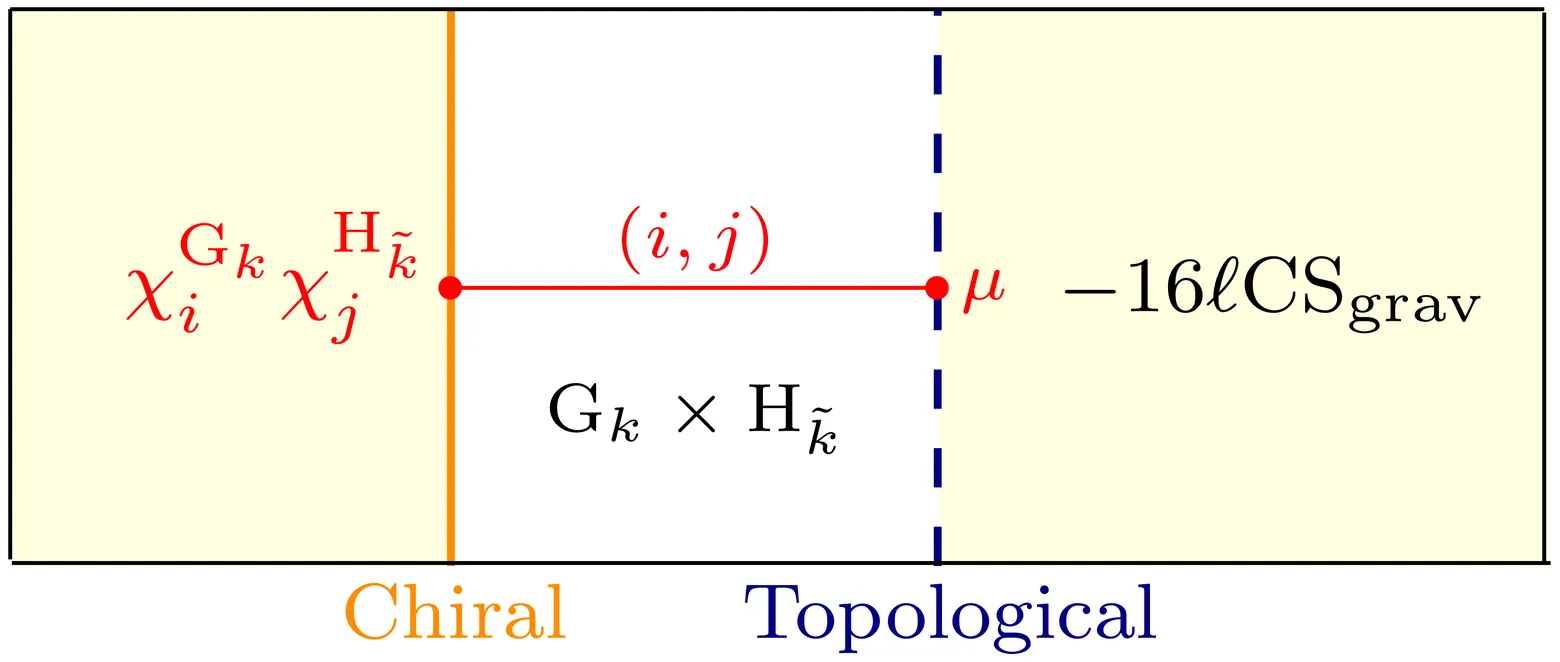
We study the interplay between holomorphic conformal field theory and dualities of 3D topological quantum field theories generalizing the paradigm of level-rank duality. A holomorphic conformal field theory with a Kac-Moody subalgebra implies a topological interface between Chern-Simons gauge theories. Upon condensing a suitable set of anyons, such an interface yields a duality between topological field theories. We illustrate this idea using the $c=24$ holomorphic theories classified by Schellekens, which leads to a list of novel sporadic dualities. Some of these dualities necessarily involve condensation of anyons with non-abelian statistics, i.e. gauging non-invertible one-form global symmetries. Several of the examples we discover generalize from $c=24$ to an infinite series. This includes the fact that Spin$(n^{2})_{2}$ is dual to a twisted dihedral group gauge theory. Finally, if $-1$ is a quadratic residue modulo $k$, we deduce the existence of a sequence of holomorphic CFTs at central charge $c=2(k-1)$ with fusion category symmetry given by $\mathrm{Spin}(k)_{2}$ or equivalently, the $\mathbb{Z}_{2}$-equivariantization of a Tambara-Yamagami fusion category.
2512.25005On-shell diagrams are gauge invariant quantities which play an important role in the description of scattering amplitudes. Based on the principles of generalized unitarity, they are given by products of elementary three-point amplitudes where the kinematics of internal on-shell legs are determined by cut conditions. In the ${\cal N}=4$ Super Yang-Mills (SYM) theory, the dual formulation for on-shell diagrams produces the same quantities as canonical forms on the Grassmannian $G(k,n)$. Most of the work in this direction has been devoted to the planar diagrams, which dominate in the large $N$ limit of gauge theories. On the mathematical side, planar on-shell diagrams correspond to cells of the positive Grassmannian $G_+(k,n)$ which have been very extensively studied in the literature in the past 20 years. In this paper, we focus on the non-planar on-shell diagrams which are relevant at finite $N$. In particular, we use the triplet formulation of Maximal-Helicity-Violating (MHV) on-shell diagrams to obtain certain regions in the Grassmannian $G(2,n)$. These regions are unions of positive Grassmannians with different orderings (referred to as oriented regions). We explore the features of these unions, and show that they are pseudo-positive geometries, in contrast to positive geometry of a single oriented region. For all non-planar diagrams which are \emph{internally planar} there always exists a strongly connected geometry, and for those that are \emph{irreducible}, there exists a geometry with no spurious facets. We also prove that the already known identity moves, square and sphere moves, form the complete set of identity moves for all MHV on-shell diagrams.
2512.19370We propose '$\mathrm{d} \mathcal{E}$-forms' as fundamental building blocks of canonical integrands for elliptic Feynman integrals, which lead to Kronecker-Eisenstein $ω$-form symbol letters. Built upon pure elliptic multiple polylogarithms, they provide a natural extension of the '$\mathrm{d} \! \log$-form' integrands and $\mathrm{d} \! \log$ letters for polylogarithmic cases. By introducing an extended basis treating all marked points equally, we manifest a hidden symmetry structure in the canonical connection matrix, and demonstrate its covariance under modular transformations. Our result provides a novel perspective on describing canonical bases and symbol letters in a unified language of pure functions.
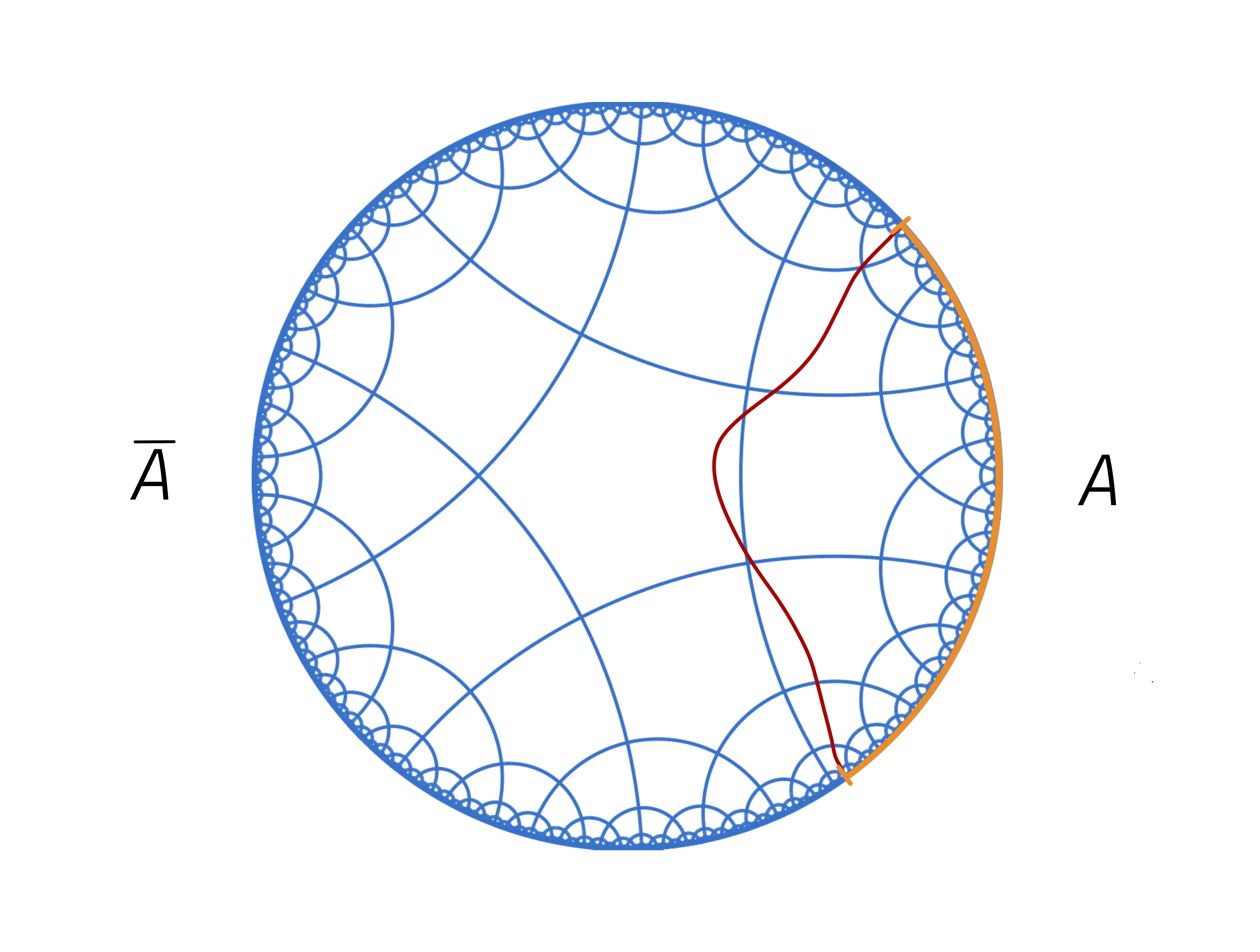
Holographic tensor networks serve as toy models for the Anti-de Sitter/Conformal Field Theory (AdS/CFT) correspondence, capturing many of its essential features in a concrete manner. However, existing holographic tensor network models remain far from a complete theory of quantum gravity. A key obstacle is their discrete structure, which only approximates the semi-classical geometry of gravity in a qualitative sense. In \cite{Lin:2024dho}, it was shown that a network of partial-entanglement-entropy (PEE) threads, which are bulk geodesics with a specific density distribution, generates a perfect tessellation of AdS space. Moreover, such PEE-network tessellations can be constructed for more general geometries using the Crofton formula. In this paper, we assign a quantum state to each vertex in the PEE network and develop two holographic tensor network models: the factorized PEE tensor network, which takes the form of a tensor product of EPR pairs, and the random PEE tensor network. In both models we reproduce the exact Ryu-Takayanagi formula by showing that the minimal number of cuts along a homologous surface in the network exactly computes the area of this surface.
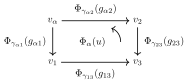
We construct a higher lattice gauge theory based on the representation of 2-groups described by a category of crossed modules on a lattice model described by path 2-groupoids. Using these lattice gauge representations, an exactly solvable Hamiltonian for topological phases in 3+1 dimensions is constructed. We show that the ground states of this model are topological observables.
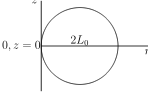
Are duality transformations symmetries of string theory? For AdS space-time the answer is no for generic asymptotic values of the moduli, since the duality symmetry is broken explicitly in the dual conformal field theory. In contrast, in string theory in flat space-time, monodromy around codimension two exotic branes show that duality transformations are spontaneously broken discrete gauge symmetries with observable consequences, provided macroscopic loops of these branes are not hidden behind an event horizon. We discuss how this can be achieved and how the situation in flat space-time differs from that in AdS space-time. We also discuss observability of codimension two non-BPS branes and codimension one BPS and non-BPS branes.
2512.19498We compute the gravitational interaction of two coalescing compact objects at sixth post-Newtonian order in the static limit, employing the diagrammatic approach within the effective field theory framework of General Relativity. The calculation requires the evaluation of six-loop Feynman diagrams that are mapped onto two-point integrals with a gauge-theory-like structure, which are computed here for the first time. The resulting seventh-order contribution in Newton's constant is finite in three space dimensions. This result provides the most technically demanding missing ingredient for the determination of the conservative dynamics of the gravitational two-body system at sixth post-Newtonian order.
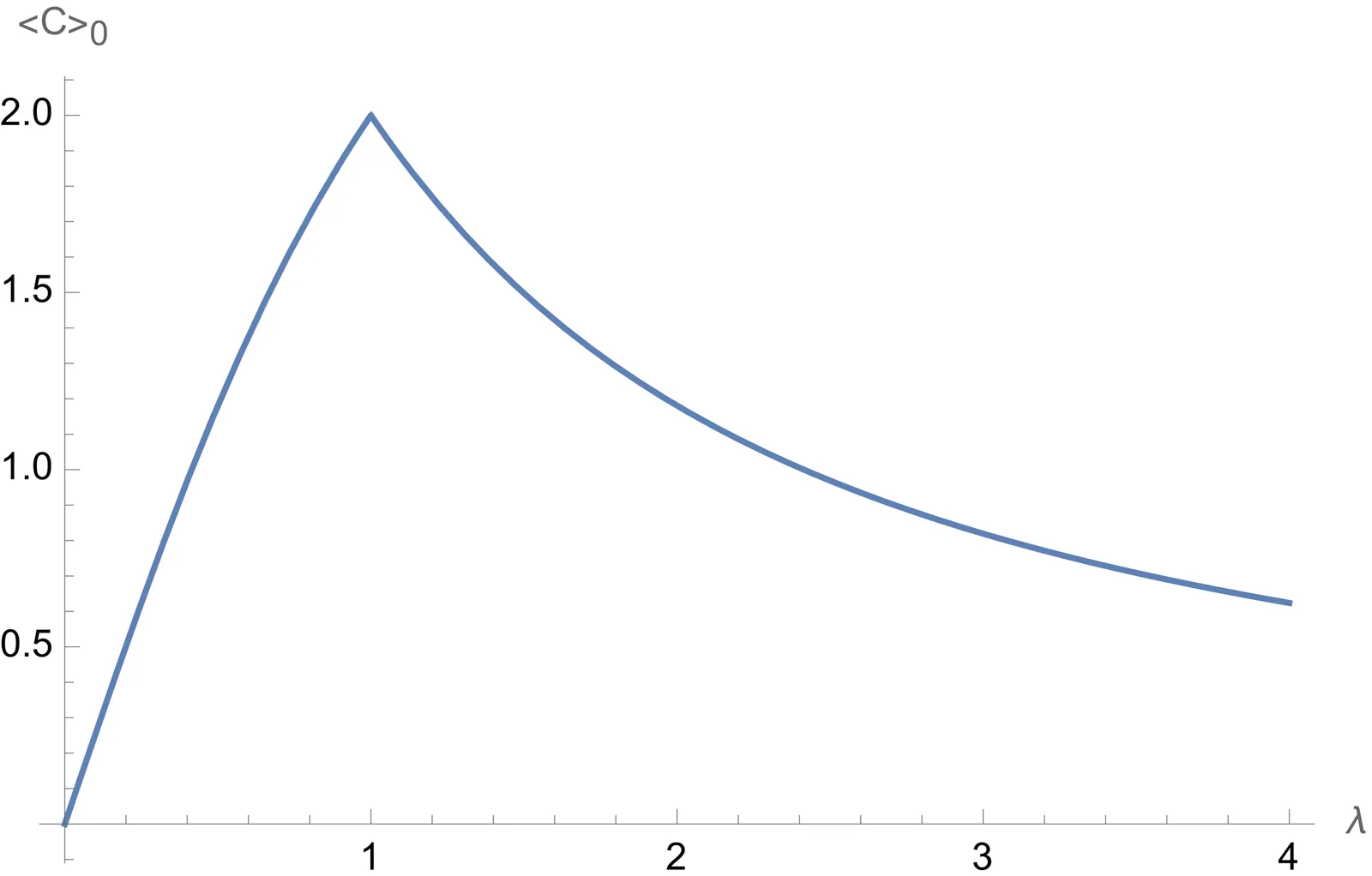
A cat state localized in the right Rindler wedge is employed to study the violation of the Bell-CHSH inequality in a relativistic scalar free Quantum Field Theory. By means of the bounded Hermitian operator $sign(\varphi(f))$, where $\varphi(f)$ stands for the smeared scalar field, it turns out that the Bell-CHSH correlator can be evaluated in closed analytic form in terms of the imaginary error function. Being the superposition of two coherent states, cat states allow for the existence of interference terms which give rise to a violation of the Bell-CHSH inequality. As such, the present setup can be considered as an explicit realization of the results obtained by Summers-Werner.

We investigate the quantum geometry of the Seiberg-Witten curve for $\mathcal{N}=2$, $\mathrm{SU(2)}^n$ linear quiver gauge theories. By applying the Weyl quantization prescription to the algebraic curve, we derive the corresponding second-order differential equation and demonstrate that it is isomorphic to the Extended Heun Equation with $n+3$ regular singular points. The physical parameters of the gauge theory are linked to the canonical coefficients of the Heun equation via a polynomial representation of the Seiberg-Witten curve. This framework provides the necessary mathematical foundation to apply non-perturbative gauge-theoretic techniques, such as instanton counting, to spectral problems in gravitational physics, most notably for higher-dimensional black holes.
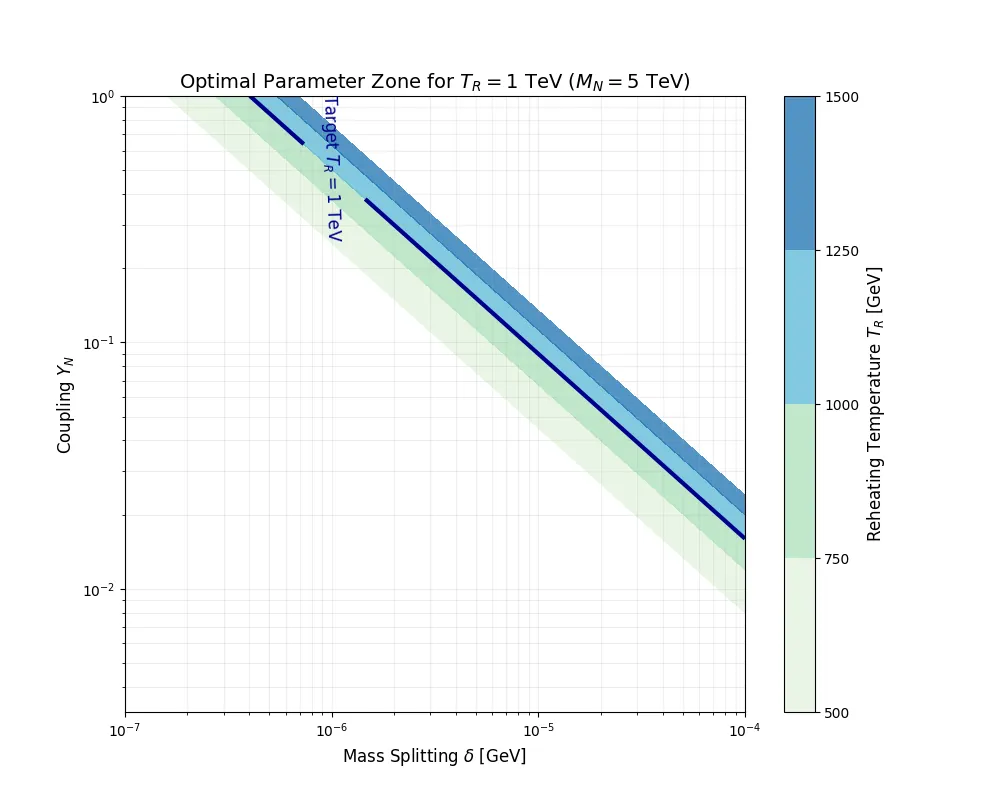
We investigate the viability of non-thermal leptogenesis in the gauged $U(1)_{B-L}$ extension of the Standard Model (BLSM) with an inverse seesaw (ISS) mechanism for neutrino mass generation. In this framework, right-handed neutrinos typically have $\mathcal{O}(1)$ Yukawa couplings, which induce strong washout effects and render conventional thermal leptogenesis ineffective. We demonstrate that a successful baryogenesis scenario can nevertheless be realized through non-thermal leptogenesis, where right-handed neutrinos are produced from the decay of the heavy $B\!-\!L$ Higgs boson $χ$. We explicitly analyze the interplay between the dilution factor $T_R/M_χ$ and the washout parameter characteristic of the ISS, highlighting the tension between suppressing washout effects and maintaining sufficient reheating. We show that a viable lepton asymmetry can be generated provided the scalar mass spectrum is appropriately tuned, allowing for a reduced reheating temperature while keeping washout under control. The resulting lepton asymmetry is efficiently converted into the observed baryon asymmetry of the Universe via sphaleron processes. Our results establish that the inverse-seesaw $B\!-\!L$ model remains a predictive and robust framework for non-thermal leptogenesis and baryogenesis.
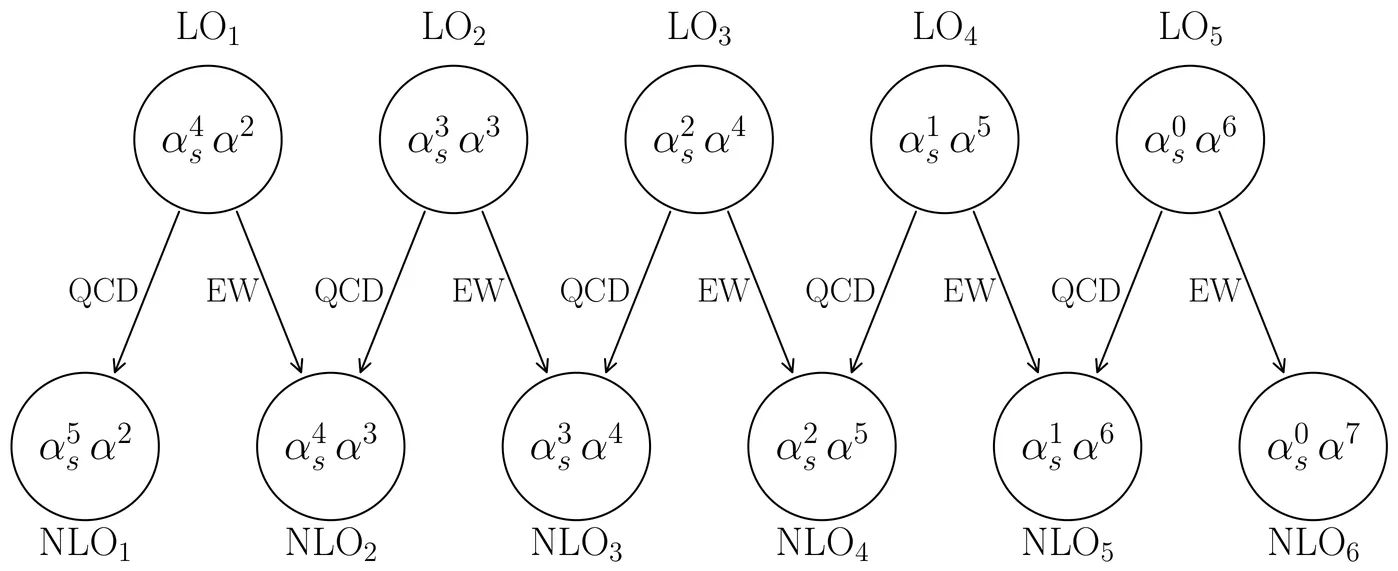
In this contribution, we summarize our results on the complete NLO predictions for the production of off-shell top quark pairs in the $\ell+j$ channel at the LHC. All NLO QCD and electroweak corrections are consistently included across the full set of LO contributions and partonic subprocesses, while retaining finite-width effects of the top quarks and the electroweak gauge bosons. Resonant and non-resonant contributions as well as interference effects are included in the complete calculation. We pay special attention to infrared singularities associated with photons and jets appearing simultaneously in the final state. Fiducial integrated and differential cross-section results are presented for $pp$ collisions at $\sqrt{s}=13.6$ TeV.
2601.05055Light bosonic fields may suffer an instability around a rotating compact object. This process, known as superradiance, leads to the exponential amplification of the field around a black hole or neutron star, while the spin of the central object is correspondingly depleted. The discovery of a highly spinning black hole could therefore be used to constrain the existence of light bosons such as axions in a particular range of masses. These constraints apply for very low non-gravitational couplings between the boson and the Standard Model, offering a powerful search strategy for new physics. However, care must be taken to include the more complex effects of the black hole's astrophysical environment. Conversely, stellar superradiance could allow us to probe additional non-gravitational interactions between a new boson at the stellar matter. In this article, I will discuss the current status and future directions of axion superradiance. This is a contribution to the proceedings of the 3rd General Meeting of the COST Action COSMIC WISPers.
2601.05037The Taub-NUT and Eguchi-Hanson gravitational instantons, along with the self-dual Plebanski-Demianski metric, form a set of Euclidean metrics which can naturally be called `self-dual black holes', as they arise from self-dual slices of the most general vacuum, asymptotically flat black hole metric. These self-dual black holes are of interest for many reasons, and can famously be described through the non-linear graviton construction of twistor theory. However, the implicit nature of this twistor description obscures some features of the underlying geometry, particularly for the most general self-dual black holes. In this paper, we give a new construction of all asymptotically flat self-dual black holes based on holomorphic quadrics in flat dual twistor space, rather than the usual twistor space associated with self-duality. Remarkably, the geometry of the self-dual black holes -- including their hyperkahler structure, as well as Kerr-Schild and Gibbons-Hawking forms -- is directly encoded in the corresponding quadric. As a consequence, we obtain a previously unknown single Kerr-Schild form of the self-dual Plebanski-Demianski metric.
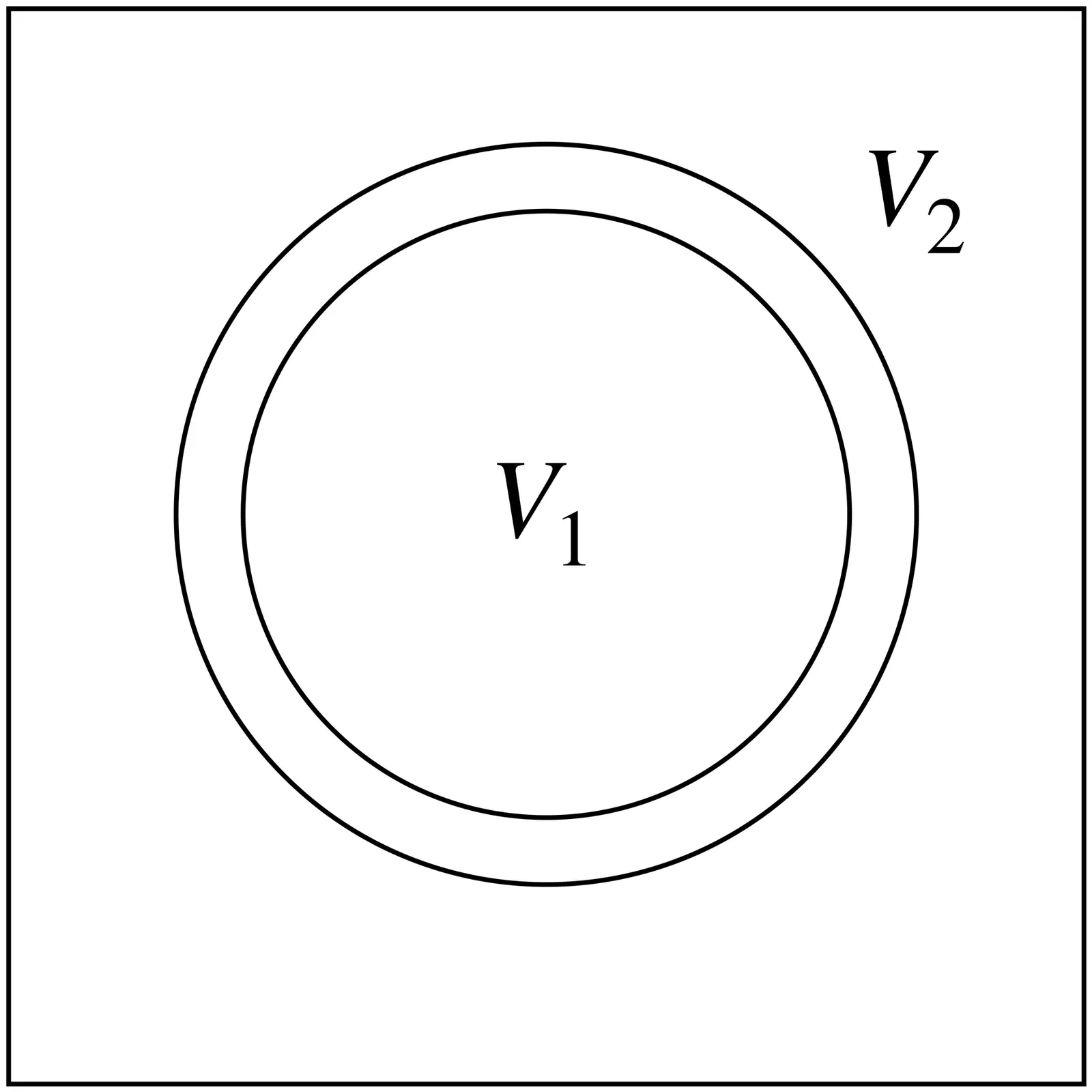
We study the entanglement negativity for the free, scalar chiral current in two spacetime dimensions, which is a simple model violating the Haag duality in regions with nontrivial topology. For the ground state of the system, both on the line and on the circle, we consider the setups given by two intervals, either adjacent or disjoint. We find analytic expressions for the moments of the partial transpose of the reduced density matrix and the logarithmic negativity. In the limit of small separation distance, this expression yields the same subleading topological contribution occurring in the mutual information. In the limit of large separation distance between the two intervals, the exponential decay of the logarithmic negativity is obtained from its analytic expression. The analytic formulas are checked against exact numerical results from a bosonic lattice model, finding a perfect agreement. We observe that, since the chiral current generates the neutral subalgebra of the full chiral Dirac fermion theory, this analysis highlights how symmetries produce nontrivial features in the entanglement structure that are analogue to those ones already observed in the mutual information for regions with nontrivial topology.
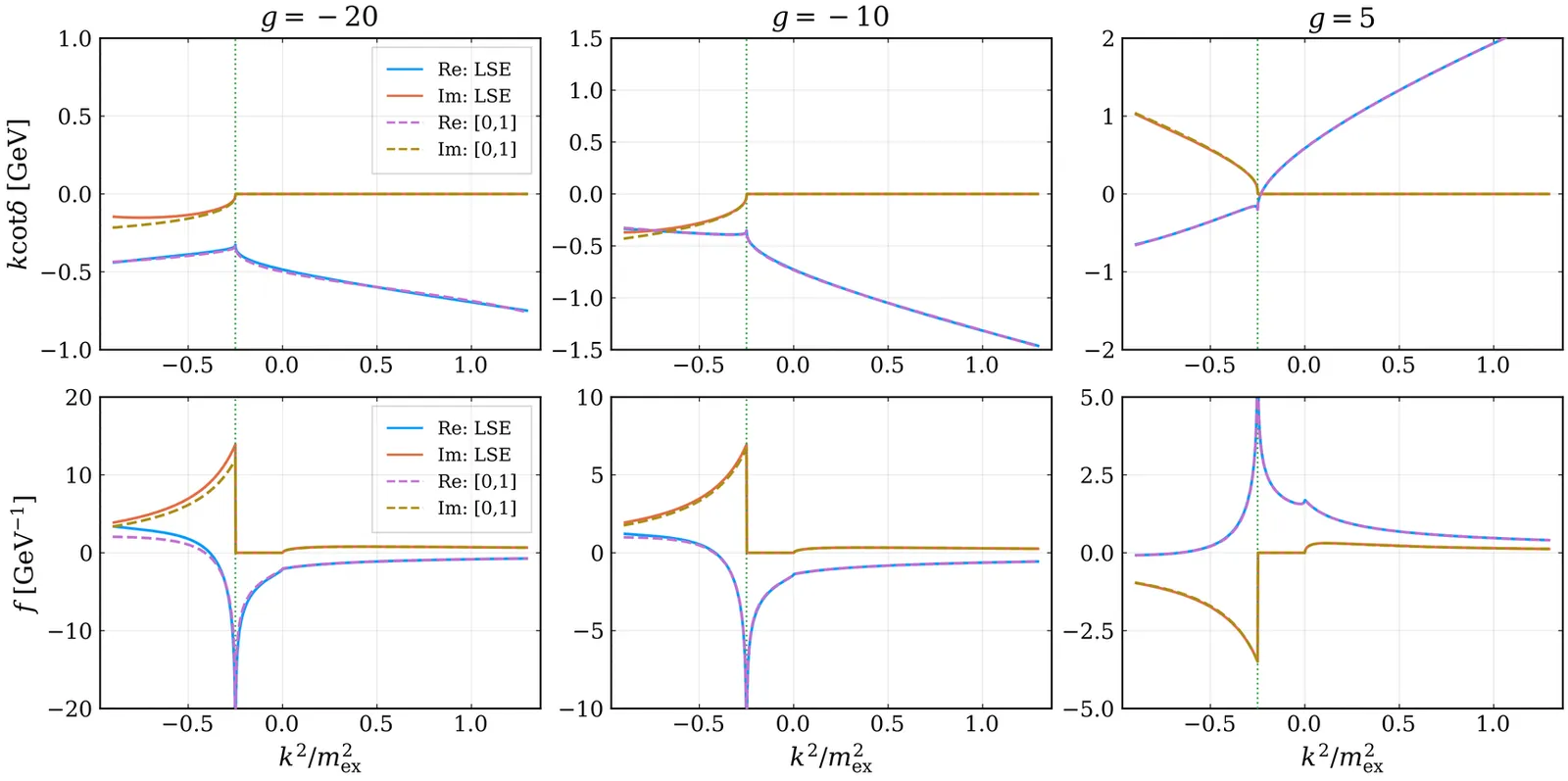
A model-independent parameterization of the low-energy scattering amplitude that incorporates the left-hand cut from one-particle exchange, an extension of the conventional effective-range expansion (ERE), was recently proposed and successfully applied to the low-energy $DD^*$ system [Phys. Rev. Lett. 135, 011903 (2025)]. While the original formulation is based on a nonrelativistic approximation and is thus limited to a [1,1] approximant for self-consistency, we extend the framework by explicitly including the higher-order terms up to $\mathcal{O}(k^6)$. We systematically investigate the reliability and robustness of the generalized ERE by incorporating relativistic kinematic effects. In addition, we develop a relativistic version of the ERE that accounts for lhc contributions. These results affirm the generalized ERE as a robust and systematically improvable framework for near-threshold scattering processes, providing both analytical and numerical reliability for applications in two-body scattering problems with a particle exchange.
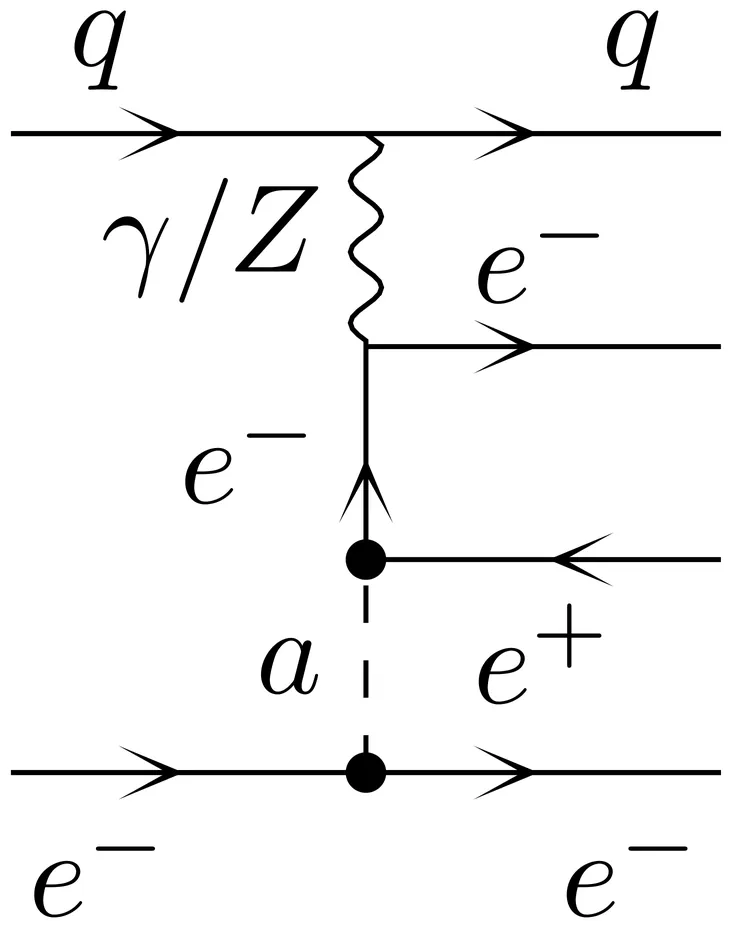
We study the sensitivity of the upcoming electron-ion (EIC) collider to purely electrophilic new physics in the GeV mass range. Within an effective field theory framework, we consider two different scenarios: an axion-like particle (ALP) and a new heavy neutral vector gauge boson $Z^\prime $, each couples to electrons only. We analyze electron-proton collisions at $\sqrt{s}= 141$ GeV with an integrated luminosity of $100~{\rm fb}^{-1}$, focusing primarily on the tri-electron final state. Additionally, loop-induced ALP-photon couplings driven photon final states are also explored. Incorporating realistic detector effects and systematic uncertainties, we obtain projected exclusion limits on the relevant cross-sections and couplings. We find that the results from EIC can significantly extend the sensitivity to electrophilic axion-like particles and $Z^\prime $ bosons in regions of parameter space that remain weakly constrained by existing experiments.

We present an NLO QCD sum rules analysis of $J^{PC}=1^{-+}$ light four-quark states, investigated several compact tetraquark and four-quark molecule states, we obtain $1^{-+}$ light four-quark states masses,. Crucially, we have not find four-quark states with mass $\sim 1.4\,\text{GeV}$, which is the interpreted to be $π_1(1400)$ exotic state in previous leading-order studies. This result do not support the existence of $π_1(1400)$ state, agrees with the current experimental observation.
2601.04910We apply the conformal compensating technique for constructing matter couplings to conformal scalars on a $D$-dimensional foliated conformal Carroll manifold dividing the tangent space into $(p+1)$-dimensional longitudinal and $(D-p-1)$-dimensional transversal directions corresponding to $p$-branes. We show that the conformal Carroll algebra that was used for particle-like foliated geometries with $p=0$ cannot be used for higher-dimensional objects, called $p$-branes, with $0 < p \le D-2$. Furthermore, string-like foliated geometries are not suitable for the conformal compensating technique due to the conformal invariance in the longitudinal directions that is present for $p=1$. All other cases can be dealt with provided one uses a different conformal extension of the Carroll algebra that amounts to a conformal extension in the longitudinal directions only supplemented with an additional an-isotropic dilatation. By brane-duality similar results hold for foliated Galilean geometries which we present as well. Our results nicely fit in with recent work on foliated Aristotelian geometries.
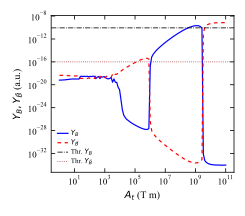
We demonstrate that primordial magnetic fields (PMF) play a decisive role in the braneworld baryogenesis scenario of [Phys. Rev. D $\textbf{110}$, 023520 (2024)], where C/CP violation arises from the coupling of visible and hidden matter-antimatter sectors through a pseudo-scalar field. Although this mechanism generates baryon number efficiently only after the quark-hadron transition, by incorporating a realistic stochastic PMF within a semi-analytical framework, we find that matching the observed baryon-antibaryon asymmetry robustly requires PMF strengths of order $10^{10}$ T right after the transition, in agreement with causal QCD-era magnetogenesis. We further reveal that magnetic fluctuations drive the baryon-density spectrum to white noise on large scales, yielding an isocurvature component compatible with Cosmic Microwave Background (CMB) bounds. This establishes a predictive link between the braneworld baryogenesis model and realistic early-Universe magnetic fields.
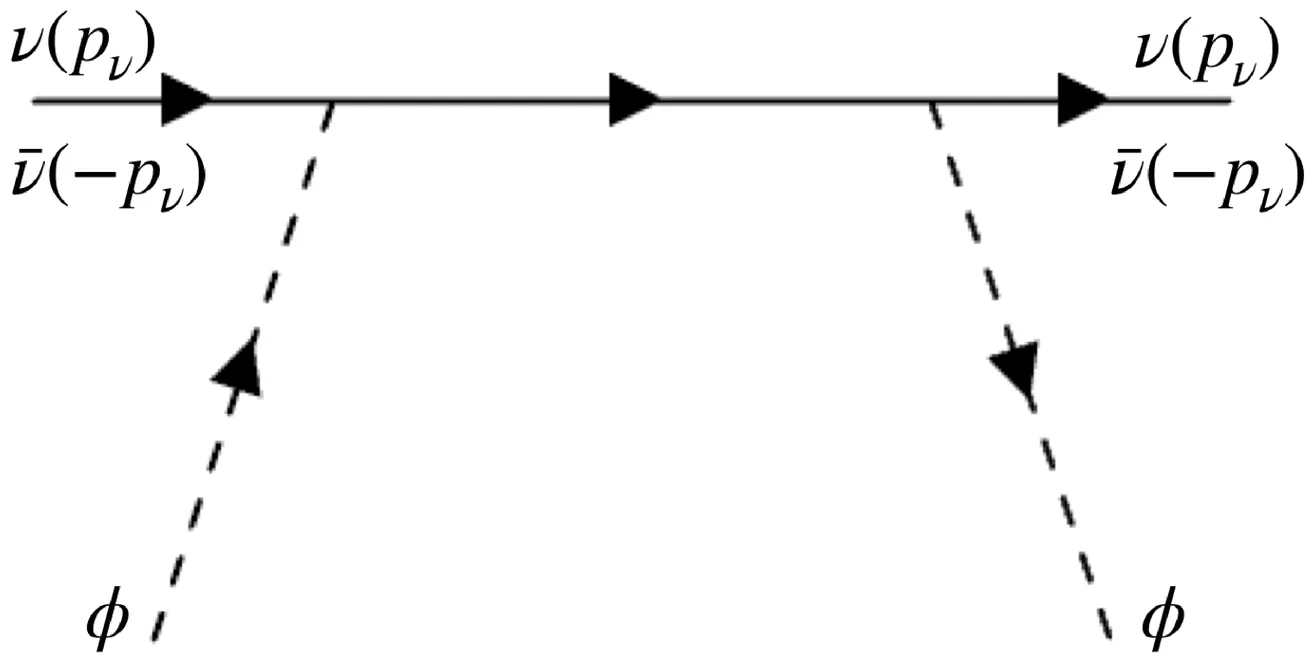
We investigate the possibility of neutrinos interacting with a scalar dark matter field and the resulting implications for neutrino oscillations in the long-baseline sector. As our Universe is predominantly composed of dark matter, neutrinos propagating over astrophysical and terrestrial baselines inevitably traverse a dark matter background. The coherent forward scattering of neutrinos in such a background induces a medium-dependent correction to the mass-squared term in the effective neutrino Hamiltonian having opposing signs for neutrinos and antineutrinos. We study how the elements of this correction matrix, arising from coherent forward scattering of neutrinos with scalar dark matter background referred to as dark non-standard interactions (dark NSI), modify neutrino oscillation probabilities. Furthermore, we also study the effect of the off-diagonal elements and the associated phases on the measurement of leptonic CP violating phase focusing on the upcoming long-baseline superbeam experiments DUNE and T2HK. We show that dark NSI can lead to substantial enhancement or suppression of CP-violation sensitivity, depending on the true values of the dark NSI phases $φ_{αβ}$. We further explored how the synergy of DUNE and T2HK can effectively mitigate the degeneracies due to the dark NSI phases, and can restore or even enhance the CP sensitivity as compared to the standard oscillation scenario.
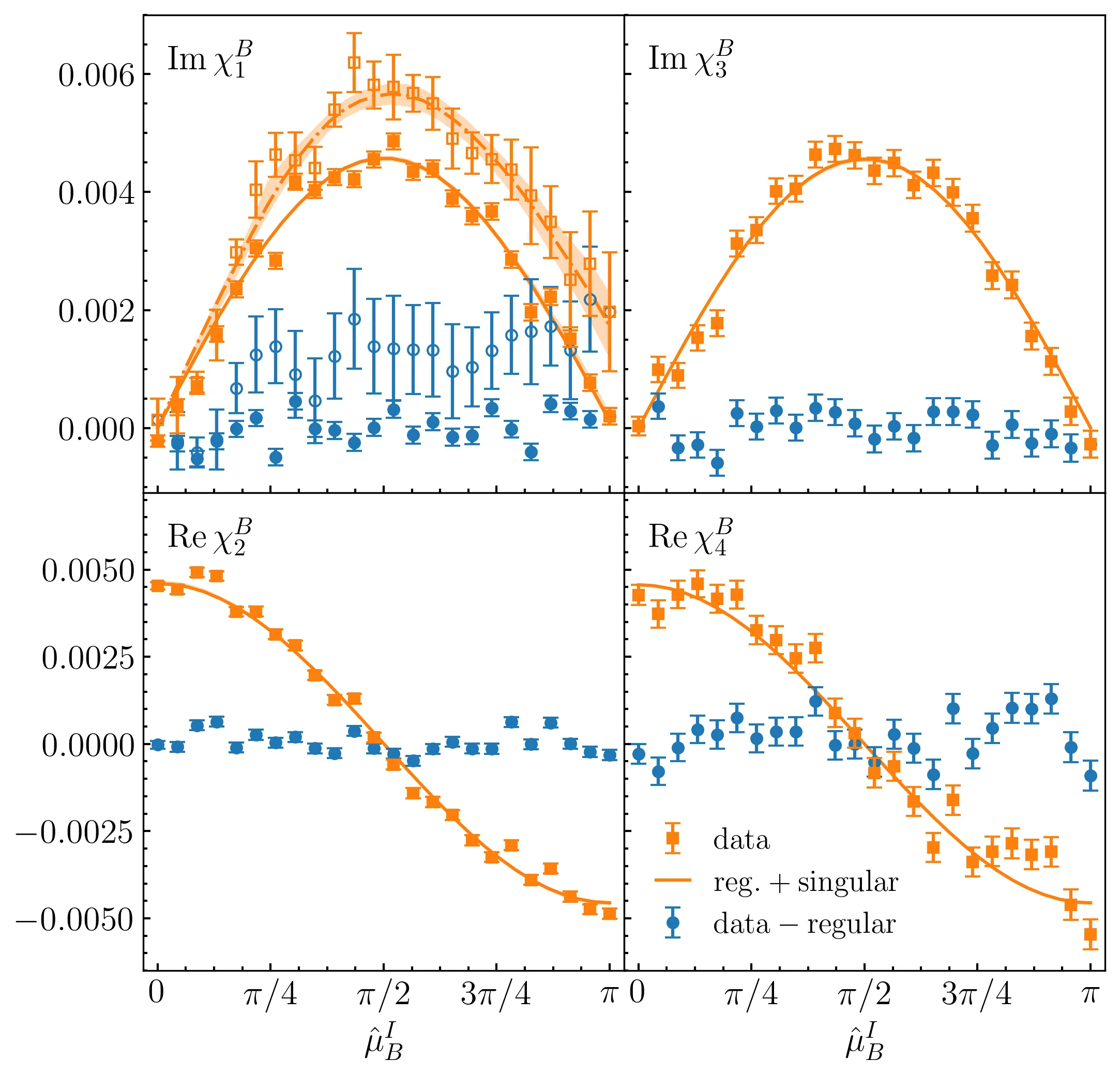
We provide the first lattice-QCD estimate of the crossover line down to $T\simeq108$~MeV. We introduce a new method that combines the Lee-Yang edge in the complex plane of baryon chemical potential $μ_B$ with universal chiral scaling to determine the $μ_B$ dependence of the QCD chiral critical and pseudo-critical temperatures. By performing $(2\!+\!1)$-flavor lattice QCD simulations at $T\simeq108$~MeV and purely imaginary $μ_B$ with a single lattice spacing and two volumes, we compute $μ_B$-dependent baryon-number susceptibilities and extract the location of the Lee-Yang edge. Together with universal scaling near the QCD chiral transition, it constrains the mapping function between $\{T,μ_B\}$ and the scaling variable (\textit{i.e.}\ the argument of the universal scaling functions). This mapping function then yields the $μ_B$ dependence of the critical and pseudo-critical temperatures for $T\gtrsim108$~MeV. While our calculation is performed only at a single value of low temperature without explicit input from small-$μ_B$ expansion, the resulting $μ_B$ dependence of the pseudo-critical temperature is consistent with established lattice-QCD determinations at small $μ_B$ and compatible with chemical freeze-out parameters of heavy-ion collisions down to low temperatures, demonstrating the validity and robustness of the method. Application of this method can be systematically extended to additional temperatures and finer discretizations, opening a pathway to charting the QCD phase diagram in the low-$T$, high-$μ_B$ regime.
2601.04718Motivated by recent claims questioning the existence of strong CP violation, we present a pedagogical review of CP violation in Quantum Chromodynamics (QCD). Using fundamental properties of the QCD partition function, we analyze the dependence of the chiral quark and CP violating gluon condensates on the theta parameter and the quark masses in the chiral limit. We show explicitly how CP violation arises, clarify the role of the axial U(1) anomaly and the ordering of the infinite-volume limit, and discuss the conditions under which CP symmetry may or may not be realized, including in the large-N framework. Our results reaffirm the presence of strong CP violation for physically relevant parameters and thus the theoretical basis of the strong CP problem and axion physics.
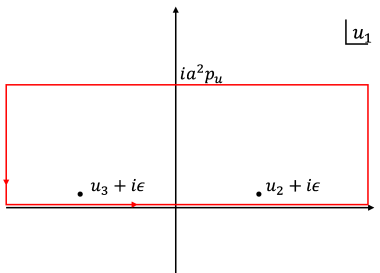
We investigate how the gravitational effects of a black hole manifest themselves as thermal behavior in the dual finite-temperature conformal field theory (CFT). In the holographic framework of AdS/CFT, we analyze a wave packet propagating into a black hole geometry in the bulk by computing three-point functions of a scalar primary operator in the boundary CFT. Our setup captures thermal signatures such as exponential damping of the expectation value, which are absent at zero-temperature. This provides a concrete and analytically tractable example of how black hole physics can be probed from the CFT side.
2601.04642We construct a four-dimensional conformal amplitude whose four-point structure matches the Virasoro-Shapiro form familiar from string theory. The construction uses only general principles of conformal field theory - radial quantization, scale invariance, and analyticity - and does not rely on worldsheet geometry or string degrees of freedom. The resulting object is a kinematical, first quantized amplitude defined by symmetry and consistency, providing a four-dimensional realization of stringlike analytic structure and a concrete target for amplitude bootstrap approaches.
2601.04624We construct the index saddle for the supersymmetric F1--P black ring. Our construction proceeds by taking a supersymmetric limit of a non-supersymmetric doubly spinning F1--P black ring. We express the resulting saddle as a three-center Bena--Warner solution. The black ring saddle possesses a finite-area event horizon, yet the two-derivative index vanishes. The solution is singular on certain subspaces of the horizon, where higher-derivative corrections are expected to become important. We argue that, once such corrections are taken into account, the solution can yield a finite result. In particular, we present a scaling analysis showing that the index agrees with the microscopic result, up to an overall numerical constant that cannot be fixed by the scaling argument alone. This analysis applies only within a restricted region of parameter space, whose full significance is not yet fully understood.
2601.04623We construct singly and doubly spinning non-supersymmetric F1--P black ring solutions in five-dimensional supergravity. These black rings have regular horizons and non-zero temperature. The singly spinning configuration lies in the duality orbit of the black ring constructed by Elvang, Emparan, and Figueras, while the doubly spinning configuration is a charged extension of the black ring constructed by Chen, Hong, and Teo. We analyze the physical properties of these solutions and the various limits they admit. In particular, the doubly spinning solution admits an extremal limit in which the entropy satisfies the relation S= 2 πJ_φ, thereby linking it directly to the angular momentum on the S^2.
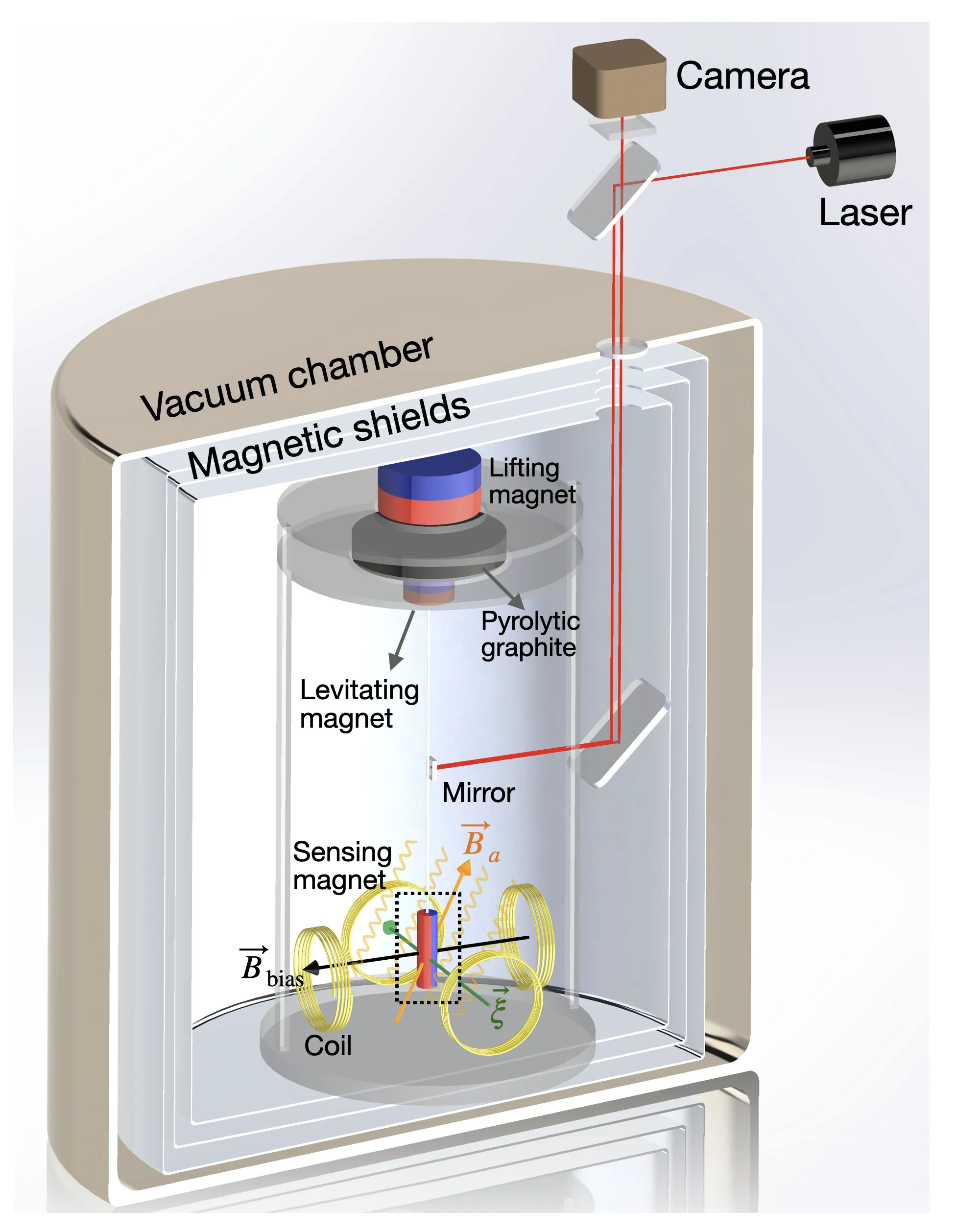
We present a search for ultralight axion dark matter coupled to electron spins using a levitated ferromagnetic torsional oscillator (FMTO). This platform directly measures axion-induced torques on a macroscopic spin-polarized body, combining large spin density with strong mechanical isolation to probe magnetic fluctuations below 10 Hz while suppressing gradient-field noise. In a first implementation, the experiment yielded 18000 s of analyzable data at room temperature under high vacuum with optical readout and triple-layer magnetic shielding. A likelihood-based statistical framework, incorporating stochastic fluctuations in the axion-field amplitude, was used to evaluate the data. No excess consistent with an axion-induced pseudo-magnetic field was observed near 2e-14 eV. To account for possible shielding-induced signal attenuation, we quantify its effect and report both the uncorrected (g_aee < 1e-7) and attenuation-corrected (g_aee < 6e-5) 90% CL limits on the axion-electron coupling. Looking ahead, improvements guided by both noise-budget analysis and shielding-attenuation considerations, including optimized levitation geometry, cryogenic operation, and superconducting shielding, are expected to boost sensitivity by multiple orders of magnitude.